Tesla Prevails in Touchscreen Defect Lawsuit
A federal court’s ruling underscores the evidentiary burden plaintiffs face when alleging complex vehicle software defects.
Published on
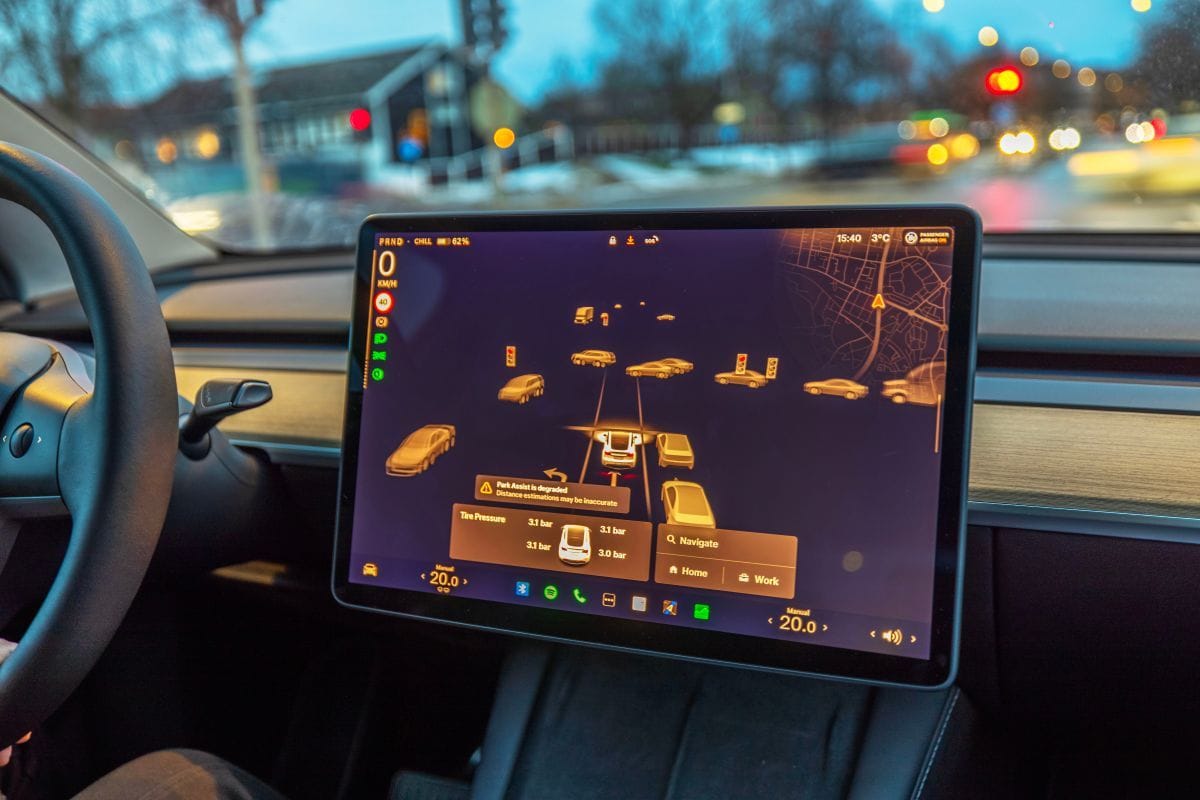
A New York motorist brought a product liability action against Tesla Inc., alleging that a defective touchscreen in her Model 3 sedan malfunctioned during hazardous driving conditions and contributed to a crash. According to court filings, the incident occurred as the driver encountered icy road conditions and hydroplaned, ultimately striking a center divider. The plaintiff claimed the vehicle’s central touchscreen froze, went black, and failed to provide alerts at a critical moment, which she argued worsened the accident and led to unspecified injuries.
The lawsuit asserted that Tesla manufactured and sold a vehicle with a defective touchscreen system that was unreasonably dangerous. The plaintiff alleged that the system’s failure deprived her of warnings and secondary safety features during the loss of traction, impairing her ability to respond appropriately as the vehicle slipped on the roadway.
Tesla denied the allegations, maintaining that even if the touchscreen display temporarily failed, the vehicle’s primary driving functions—steering, braking, and acceleration—remained fully operational. The company contended that the accident was attributable to weather and road conditions rather than any alleged defect in the vehicle’s electronic systems.
Procedural Posture and Summary Judgment
The case proceeded in the U.S. District Court for the Southern District of New York. After discovery, Tesla moved for summary judgment, arguing that the plaintiff could not meet her burden of proof on essential elements of her claims. Specifically, Tesla asserted that the plaintiff failed to provide expert testimony linking the alleged touchscreen malfunction to the cause of the crash or demonstrating that the design or manufacture of the touchscreen system was defective.
U.S. District Judge Nelson Roman granted Tesla’s motion, issuing a 15-page opinion that dismissed all claims. The court concluded that the plaintiff had not produced sufficient admissible evidence to allow a reasonable jury to find in her favor on manufacturing defect, design defect, or failure-to-warn theories.
The ruling highlights the procedural significance of summary judgment in complex product liability cases, particularly where claims depend on technical or scientific issues beyond common experience.
Expert Testimony and Manufacturing Defect Analysis
Central to the court’s decision was the absence of expert testimony supporting the plaintiff’s theory of causation. Judge Roman emphasized that claims involving complex vehicle software and integrated electronic systems typically require expert analysis to establish both the existence of a defect and a causal connection to the alleged harm.
“Where, as here, the claim turns on the alleged malfunction of complex vehicle software and integrated electronic systems, expert testimony is generally required to establish both defect and causation,” the court wrote. The judge further noted that such matters “are beyond the understanding of an ordinary juror, and cannot be established through lay testimony or speculation.”
While the plaintiff relied on her own observations of the touchscreen going black, she did not submit an expert report explaining how that malfunction caused or contributed to the crash. Tesla, by contrast, retained an expert who opined that even if the touchscreen display failed, the vehicle’s primary control systems would remain available to the driver.
Absent expert testimony “linking the alleged touchscreen failure to a loss of vehicle control,” the court found that the plaintiff could not establish a specific manufacturing defect or proximate causation.
Design Defect and Failure-to-Warn Claims
The court applied similar reasoning to dismiss the plaintiff’s design defect and failure-to-warn claims. Under New York law, a design defect claim typically requires proof that a product was not reasonably safe and that a feasible, safer alternative design existed. Judge Roman found that the plaintiff had not designated any expert capable of addressing the touchscreen system’s design, the engineering tradeoffs involved, or the feasibility of alternative designs.
“Without such testimony,” the court stated, “plaintiff cannot establish that the design was not reasonably safe under the risk-utility framework or that any alleged design feature caused the accident.”
The failure-to-warn claim also faltered due to the lack of expert support. The plaintiff did not present evidence demonstrating that Tesla had a duty to warn about specific risks associated with touchscreen failure, nor did she show that any alleged warning deficiency was a proximate cause of the crash.
Alternative Causes and New York Product Liability Standards
In addition to the lack of expert evidence, the court found that the plaintiff failed to exclude other plausible causes of the accident. New York’s circumstantial-defect doctrine requires a plaintiff to rule out reasonable alternative explanations for an incident when relying on circumstantial evidence of a defect.
Here, the record included evidence of adverse weather, icy road conditions, and hydroplaning. Tesla argued that these factors independently explained the loss of control. Judge Roman agreed, noting that the plaintiff offered “no expert testimony whatsoever — and no other competent evidence — excluding these alternative causes.”
This failure was “dispositive,” the court concluded, reinforcing the principle that plaintiffs must affirmatively address and eliminate other likely explanations when pursuing product liability claims based on circumstantial proof.
Implications for Automotive Product Liability Litigation
The decision underscores the critical role of expert testimony in cases involving advanced vehicle technologies. As automobiles increasingly rely on integrated software systems and electronic interfaces, courts continue to require rigorous technical evidence to substantiate claims of defect and causation.
For manufacturers, the ruling illustrates the effectiveness of challenging the evidentiary foundations of claims at the summary judgment stage. For plaintiffs, it serves as a cautionary example of the necessity of early and robust expert involvement when alleging defects in complex automotive systems.
Case Details
Case Name: Wilson-Wolf v. Tesla Vehicles
Court Name: (U.S. District Court for the Southern District of New York)
Case Number: 7:22-cv-10066
Plaintiff Attorney(s): Redmond Law PLLC
Defense Attorney(s): Nelson Mullins Riley & Scarborough LLP